Sunday, December 9, 2012

19: Florence, March 1932


View Larger Map
Arrived in Florence (A), Italian Firenze, afternoon of March 21st. Beautiful old palaces and art galleries and black and white marble cathedral, with Piazza del Duomo in front. Michelangelo’s statue of David prominent in another square.

Campanile and dome of the Duomo (Cathedral)
Florence
Campanile is from design by Giotto and was begun in 1334.  276 ft. high.
March 1932 

Florence Cathedral and Bell Tower, March 2026
Credit: Evan and Emily Farrer

David, now inside the Accademia Museum, is truly stunning
Credit: Evan and Emily Farrer, March 2026

Church of Santa Croce
(from 13th to mid 15th Centuries)
Florence
Contains tombs of Michelangolo [sic], Galileo, Rossini, et al. 

Church of Santa Croce exterior, March 2026
We were on an e-bike tour and unable to go inside. I showed the tour guide Fawz's interior picture, and he said that was one of the best he had ever seen because there was flooding some time after Fawz took his picture which caused damage.
Credit: Emily Farrer

Portion of wing of Pitti Palace. Boboli Gardens, and tower of Palazzo Vecchio.
Florence
March 1932 

An street-side wing of the Pitti Palace while on our e-bike tour, March 2026
Credit: Evan and Emily Farrer

Same tower that Fawz saw, but from the perspective at Michelangelo Point, March 2026
Credit: Emily Farrer

In Boboli Gardens
Pitti Palazzo
Florence
March 1932

In courtyard of Palazzo Ricardi, one of old homes of Medici family, now partly public offices, 
partly museum.
Florence.
March 1932

Entrance to Palazzo Ricardi, but the courtyard where Fawz went is inaccessible to the public now.
Credit: Evan Farrer, March 2026

Sunday, December 2, 2012

18: Greece and Venice, March 1932


View Larger Map

We saw lots of porpoises in the Sea of Marmora (A) going out. They were very beautiful and playful. Arrived at Piraeus, Greece, (B) morning of March 14 and caught a taxi five miles to Athens (C) and the Acropolis. Beautiful hill and real architecture. Saw large groups of the "Ladies from Hell," elite Greek soldiers who wear kilts and shoes with pointed toes which curve upward. Sailed through Corinth Canal  (D) which is cut through stone isthmus near ancient city of Corinth. Ship has only a few feet clearance on each side from stone banks.

Ship next steamed into Adriatic Sea and north to Venice (E). Italian police and soldiers are picturesque. Some wear Napoleon-like hats, others with Robin Hood hats with feather and cloaks. We passed many sailing ships in Adriatic which on March 16th was fairly cool, misty and cloudy.

We see several leaning towers as we pulled into the dock at Venice. Went to nearby Pension Seguso and to the San Marco nearby. This is great cathedral erected supposedly over the bones of St. Mark, their patron saint who died in Alexandria, Egypt, but who had been promised by an angel that his bones would rest in Venice. The body was smuggled out of Alexandria under pork carcases and taken to Venice. The basilica seems all domes and gilt with a number of fine mosaics in beautiful colors and showing fine scenes in the arches below.

Piazza San Marco
Church and Companile.
Present building completed 1094.  First Ducal chapel on this site finished about 832.  St. Mark's remains brought to Venice in 828.
Venice
March 1932 

Sadly, I failed to get the same angle that Fawz had, but this is St. Mark's Campanile that we got to go up in (it was very cold), March 2026. Credit: Emily Farrer

St. Mark's Basilica, March 2026
Credit: Evan Farrer

Next east is the Doge's Palace, a beautiful structure with many huge beautiful historic paintings inside. Above the central arch of the San Marco, by the way, are four bronze horses taken as booty by Venetians when they captured Byzantium (Istanbul). I was in Venice for Palm Sunday, a great religious day for Catholics. Huge crowds poured out of the cathedral, each person carrying a small sprig resembling palms. Saw many fine museums and art galleries. I liked particularly the paintings of Tintoretto. To get very far in Venice you catch a motor boat. Gondolas were slow and expensive. Venice is on 100 islands separated by almost 150 canals crossed by about 380 bridges. Adjoining the San Marco, by the way is a high bell tower with a winged lion atop.

Doge Palace, March 2026
Credit: Emily Farrer


On Grand Canal
Venice
Taken from Gondola
March 1932

On Grand Canal Gondola, March 2026
Credit: Emily Farrer

Friday, November 30, 2012

17: Island of Rhodes, Roman Ruins, and Turkey, March 1932


View Larger Map

March 7 landed at Beirut,  Lebanon (A). Mountainous in interior, some were snow capped.

 
 March 1932
Island of Rhodes

Island of Rhodes
Fileremo, formerly the Acropolis of Ialysus
March 1932

Stopped at Island of Rhodes (B) March 9. Rocky, Saw some Roman ruins. Beautiful scenery. Sail into the Dardanelles straits (C) and see some of the old stone forts still there, through the Sea of Marmora (D), which is so big you see no land and though the Bosporus to Istanbul. Saw Mosque of Sancta Sophia, erected originally by the Emperor Constantine, reconstructed by Theodosius and finally by Justinian in about 538 A.D. It has a gigantic dome with flying buttresses and a number of auxiliary domes, semi-domes and interior round arches. It is an impressive sight inside. I set my camera for time exposure and had the picture when a Mohammedan priest told me no pictures were allowed inside [see interior below]. I was so flustered that I later took a second exposure over the same film.

Mosque of St. Sophia
Istanbul
March 1932


The modern Turks wear clothing similar to ours, use the same alphabet and letters we use and the women no longer wear veils as we had seen in Egypt and Palestine.

Sunday, November 25, 2012

16: The Holy Land, February - March, 1932


View Larger Map

February 25 I caught the train for Jerusalem at 6 p.m. I curled up in a blanket I had with me. The country got more and more mountainous after we crossed the Suez Canal. Went through a real sandstorm and then into beautiful orange growing country and through mountains to Jerusalem. Cook’s dragoman met me at the train the morning of February 26th and took me by roadway cut through big wall when Kaiser Wilhelm of Germany visited there in 1898.

Clarence on Donkey
Pool of Siloam (near)
Village of Silwan (Siloam)
Junction of Tyropean and Kidron Valleys
Christ anointed the blind man's eyes, presumably near here.
January 1932
Mainly Yemen Jews (Living in Islam since Mohammedan times and speak Arabic as well as Jewish.) 

Clarence on Donkey
Valley of Kidron
Tomb of Absolam
Graeco-Roman style
Associated with David's son since 16th Century.

Tomb of Absolam, Wikipedia

That morning we visited the Church of the Holy Sepulcher, supposedly the site of both Golgotha and crucifixion and entombment, all according to Queen Helena, mother of Constantine, first Christian Emperor of Rome. This consists of several interconnected dark churches with many candles and bickering clergy of Roman and Greek Catholics, Armenian Catholics, and Copts (Egyptian Christians). This is all now inside city wall but was outside at the time of the Savior. Present churches are described as a barbarous reconstruction of medieval structures razed by fire in 1808. We proceeded along the Via Dolorosa, supposedly the road which Christ trod, but actually about 30 feet higher since one city has been built on ruins of the other successively here. Came to the site presumedly of all where Pilate delivered judgment.

Clarence
El 'Azariyeh (Bethany)
Supposed house of Simon the Leper where women anointed Christ with ointment
January 1932

Source: Ancient Faces

In the afternoon motored to Bethlehem, 5 ½ miles south and a little east of Jerusalem. Great fortress-like buildings comprise the Church of the Nativity with three contiguous convents maintained by Latin, Greek Orthodox, and Armenian churches. The traditional site of the nativity is a cave beneath the choir of the church.

I visited Dome of the Rock on Mt. Moriah February 29th. Byzantine (Greek) architects built the present domed structure in about the seventh century for Arabs controlling the area. A sum equal to about the revenues of Egypt for several years was appropriated. The dome is very beautiful, startling in design and gorgeous in coloring. Stained glass windows in cement frames in beautiful arches with blue and white tile. The tiles were added by Suleiman the Magnificent in 1561. Passages from the Koran, white on a blue enamel background are prominent. Guide says some of the supposed 17th Century windows were put there after a 1927 earthquake. Very dim on the inside, but soon fine coloring of the interior begins to penetrate. Great rough rock is surrounded by a fine grille of French wrought iron. Rock is supposed to be where Melchizedek offered sacrifice, where Abraham was about to offer up Isaac, and where Mohammed was translated to heaven on back of his white steed. It is the spot where the ark of the covenant stood. Through a pointed door we descended 11 steps to the grotto where blood from sacrifices was supposed to come down. Solomon’s stables were below gratings. At Wailing Wall, remains of the original wall of Herod’s Temple, many Jews were praying and were crying.

Looking across Kidron to East walls of Jerusalem and Haran enclosure (Solomon's temple) from solid "Tomb" of Zachariah.

Tomb of Zachariah, Wikipedia

March 1, I went up Mt. of Olives across the valley to the east. On the way I stopped at the Garden of Gethsemane and saw really old olive trees where Christ supposedly prayed and sweat drops of blood. I then went to the summit of the Mount of Olives and climbed 214 steps to the top of a tower from which we could see the great vista through a rainstorm.

Clarence
Minaret near Chapel of Ascension
Mt. of Olives
February 1932

Also I went to Gordon’s Calvary and Golgotha as accepted by the Church of England. This is outside the present city wall. Later I climbed the city wall and walked around the city. King David Hotel and modern city are outside the city walls.

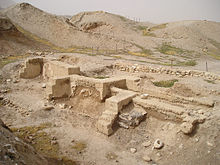
Guide at excavations of ancient (Biblical) city of Jericho.
February 1932

Image: Wikipedia

Also I drove over surfaced highway through Wilderness of Judea past ruins of Inn of the Good Samaritan to Jericho where I had lunch. Went south to the Dead Sea, where I took a swim.


Clarence
Dead Sea
February 1932

Image: Wikipedia

Left Jerusalem by car early morning of March 5. Stopped at a place where Jesus supposedly conversed with the Samaritan woman at the well. Had lunch at Nazareth and descended from the hills through Cana to blue Lake Galilee which is 622 feet below sea level. Nearby Mt. Hermon with snow is 9,000 feet above sea level. Stayed overnight at a good hotel along the lake. Took a half hour’s boat ride on the lake which still yields lots of fish. It takes a little more than half an hour to dive from Nazareth to modern port of Haifa. Mt. Carmel is on point at end of great curve of Bay of Acre. Boarded the Italia a small Italian ship, traveling 3rd class distincta (special). Wisconsin couple who had traveled on the “Ubena” first class and had stayed at the Grand New Hotel with me in Jerusalem were aboard.

Thursday, November 22, 2012

15: On to Egypt, February 1932


View Larger Map

Steamed up the Red Sea February 15th through 17th with haze and fog the rule. One beautiful sunset which disclosed high mountains to the north. With Rev. Winter won men’s doubles in table tennis, with Mrs. Noyes won mixed doubles in shuffleboard and was on the winning team of six in tug of war.

Arrived at Suez at south end of the Suez Canal February 18th at 6 p.m. The canal is wide enough for two ships to pass each other. There was a little signal station every several miles. On the Egyptian side are palms frequently and some farms. Palestine side at first is plain desert with a camel visible now and then. Ismailia is a good-sized city where major traffic crosses between the two countries.


Nile at Cairo
February 1932


Landing at Port Said was quite a chore. Arabs, which I will use to describe most Egyptians, are a tricky and grabby lot. I passed through customs and health check and caught the train for Cairo. The country is very green. Here and there was a canal which you could detect ahead because the forest of masts of small ships. We saw many primitive methods for raising water from canals such as the crank and screw method almost like a meat grinder, and by a pot on a derrick. I also saw plowing by primitive wooden blade and pulled sometimes by a camel and a cow attached together.


Nile near Cairo
February 1932 

On the Nile near Cairo
February 1932 

I arrived at Cairo in the afternoon of February 19th and taxied to small pension (hotel). Mohammed Solomon, dragoman (guide), took me to an Egyptian theater and we watched dancers. Many veiled women and lots of French women (many prostitutes) on the streets.

I left next morning at 8 a.m. for Memphis and the Sakkara Step Pyramid. Dragoman said there are 49 pyramids. Viewed a colossus statue of Ramses II lying out flat with head broken off. Then went on and found similar statue in alabaster marble under roof, head intact. I went in one artificial cavern where there were sarcophagi for 24 sacred bulls. Then drove north to Great Pyramid. The main entrance was walled up but a new entrance was wide enough to enter. On each side of the steep passageway were shelves flanking center groove. At intervals of several feet were rectangular holes where slaves could rest from their labors of pushing sarcophagi up. The King’s chamber was just half way up from all directions. The Queen’s was on-fourth and the daughter’s was three-fourths of the way up. Immense stones supported the roof. Interior stones irregular, only the outer stones were fitted. The two great pyramids were encased with marble (alabaster) which was purloined by Arabs for mosque building from all but the top quarter of the next to largest pyramid.


February 1932
Note alabaster capping stone left undisturbed on top portion of second largest pyramid. 

Image: Wikipedia

Napoleon wanted to move the Sphinx which is carved out of solid stone, but was unable, so he fired a cannon at it and knocked off the nose. The Sphinx has a body of a lion and a human face. I rode a camel part of the way around the pyramid. It was like going up an elevator since you mount a camel which is kneeling down. The hind end raises a notch first, then the front goes up a notch and the process continues until you seem high up in the air. Many caves and buried shrines in that area.


Two of Cairo's finest mosques, near Citadel
February 1932 

Citadel and Mosque of Mohammed Ali.
Latter is constructed of the alabaster capping stone of the Pyramids.
February 1932.

Image: Tour Egypt

Egypt then had 14 million people with cultivated land of only 14,000 square miles. One square mile had to support 1,000 people. There was much poverty and many unemployed persons. Saw many mosques, bazaars, and great museums. Cairo is a huge city. Major museum had King Tut’s golden treasures. Wooden furniture restored. It was of beautiful designs. Mummies of Ramses II and so on had all been withdrawn from the public at that time since Egyptians figured bodies should be private.

Central Hall of Egyptian Museum
Cairo

I bought traveler’s check at Thomas Cook and Sons with my gold since it was unlawful to take gold out of Egypt.

Thursday, November 15, 2012

14: Mozambique to Yemen, February 1932


View Larger Map 
Arrived at Port Amelia, February 1st, but not allowed to go ashore. Reached Daar-Es-Salaam February 3rd. This means “Haven of Peace” in Arabic. Formerly German East Africa, then British East Africa. Beautiful green palm trees. This is the center of native shipping industry. Arabian dhows sail under many flags from here carrying mangrove bark, copra and other tropical produce. The dhows stop at many lesser ports and creek mouths. Lots of Indians come aboard selling curios of ivory and ebony, also clothing, shawls, wraps and every rubber footwear.

Natives at water hole.  Dar-es-Salaam.  Also Mr. Strutt, So. Rhodesia.
Note paraffin tins (Kerosene).
February 1932


Left Daar-Es-Salaam at 6 a.m. February 4th and arrived at Zanzibar, 48 miles away, at about 11 a.m. It is the most important trade center and the largest city in East Africa. The 640 square mile island and nearby Pemba (380 sq. miles) formed a British protectorate. Population for the whole island in 1921 was: Europeans 270, Swahilis (natives) 165,000, Arabs, 20,000, Indians 15,000, Commorians 3,000. Total 203,270. We saw the sultan’s palace and traversed a maze of cross streets. English church was quite nice, built of coral and cement. Indians and natives of all varieties, most wearing white or red fez. Some lovely dates in the market but they were covered with flies. Also huge bananas. Native boys come on launch near boat and dived for coins.

Talked with a young fellow going back to his father’s farm between Mt. Kenya and Mt. Kilimanjaro*, 9,000 feet above sea level. No winter or summer but a log of rain in winter months. Big game hunters go through in summer he said. Licenses cost up to 100 pounds ($500) for aliens.


Native War Memorial
Tanga
February 1932


I also stopped briefly at Tanga [Tanzania], then went to Mombassa [Kenya], arriving February 7. Went ashore with another fellow and saw Catholic and English cathedrals with native worshipers. Big oil storage center on north side of island. Saw camels turning a primitive mill for grinding seed for oil. This port had been occupied in past by Phoenicians, Romans, Arabs, Portuguese. Legal status of slaves not abolished until 1007. We could buy a pineapple, green coconut for its milk and naartjes (tangerines) for cheap prices. Crossed the equator somewhere in that neighborhood.


Fort Jesus
Mombassa, with old tablet
January 1932
[The picture is dated January, but the narrative states February]

Image: Wikipedia

Fort Jesus, Mombassa
Old Harbor
Erected first by Portuguese
1593-5

Arrived at Aden [Yemen], a majestic sight Sunday February 14. It has great bleak mountainous precipitous barren crags and is part of a wildly distorted volcanic peninsula. It had a population of 56,000 with a fair number of impressive buildings. It was an important trade and coaling station annexed to Great Britain in 1839. Drinking water was distilled from sea water. Arab water cart was an interesting sight. The driver delivered the water in a brass jug. Arab traders and lots of Indians thronged the streets. Lots of goats around. Fish and bundles of green stuff for fodder were hawked about. We viewed at a distance a Parsee burial ground with attendant vultures. Millet in a nearby oasis is reported to grow 12 feet high.

Aden
February, 1932

*Around 2006, a son, a grand-daughter, and a grand-son went to Africa and hiked Mt. Kilimanjaro.